Heroes, Heroines, and Narrative in Paintings
How to look at a painting when the story is part of what the painting is doing.
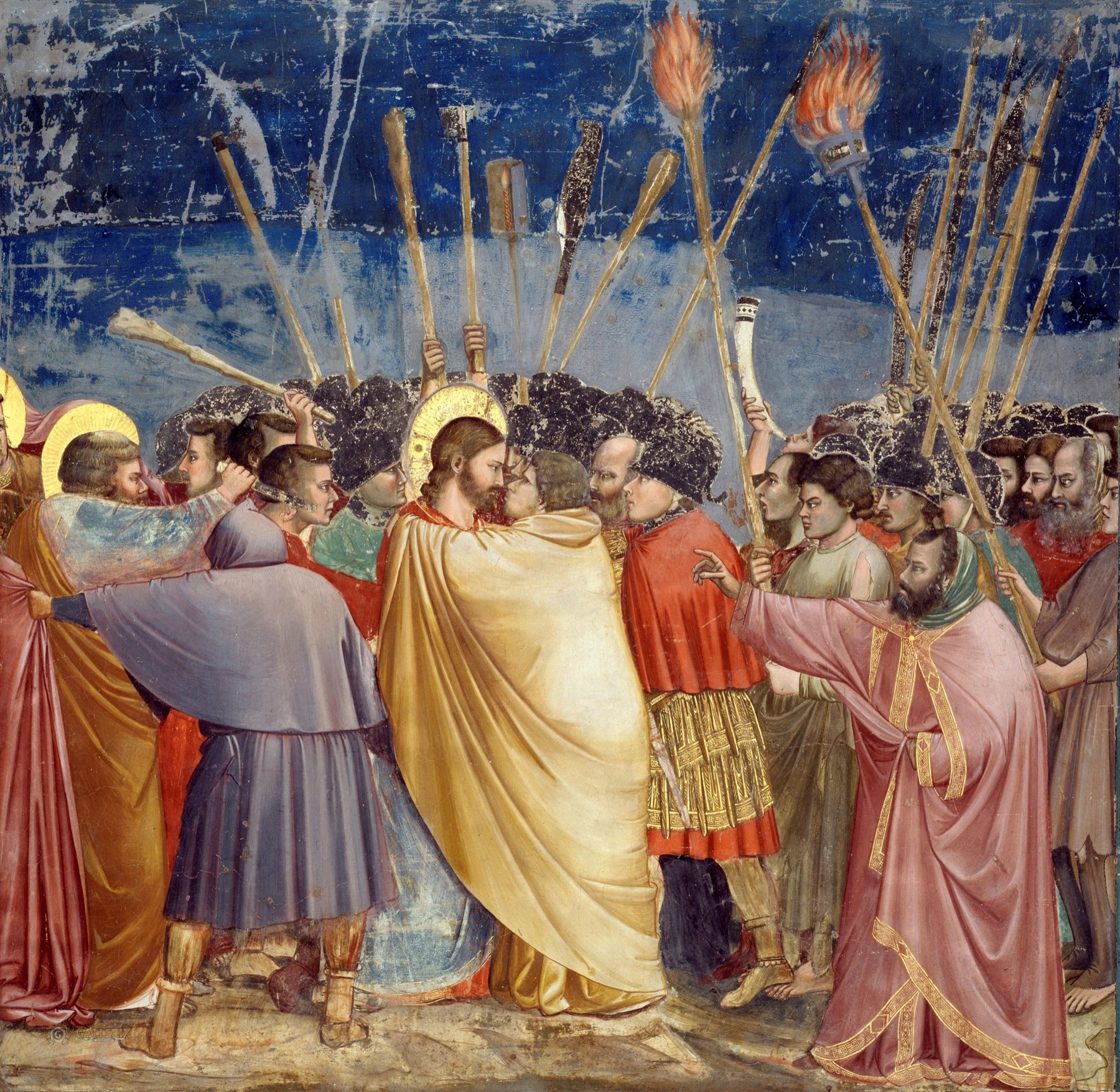
This course follows John Walsh's Yale lecture series on history painting. The lectures begin from a practical problem: if you do not know the story pictured in a painting, you may miss what the figures, gestures, and composition are trying to say.
We will move through twelve paintings from Renaissance Italy to contemporary Germany. Each lecture asks the same connected questions: what story is being shown, what moment has the painter chosen, what has been changed or invented, and what did the image want its first viewers to feel, understand, or do?
Walsh also makes the limits of the series clear. He is following one European and American tradition rather than offering a global history of visual narrative. Before turning to Renaissance Italy, he briefly points to Mesopotamian monuments, the Epic of Gilgamesh, Egyptian funerary images, Greek vases, Roman wall paintings, Chinese scrolls, and the Bayeux Tapestry. They all make the same larger point: stories preserve practical knowledge, social rules, religious expectations, and shared memories before they become written history.
The Renaissance revival of history painting was not based on direct access to most ancient pictures. Greek and Roman wall paintings had disappeared or remained buried. Artists reconstructed the tradition from classical literature, especially Alberti's historia. His treatise describes painting almost like rhetoric: the artist plans the scene, gives figures legible emotions, creates variety and dignity, and persuades the viewer through what can be seen.
Check your understanding
Why was history painting treated as the highest category of painting for centuries?
Adapted from the twelve Yale lecture transcripts published by Open Yale Courses ↗. The lecture series was recorded at the Yale University Art Gallery and presented by John Walsh.
Unintended Consequences: Antonio del Pollaiuolo's Hercules and Deianira
Antonio del Pollaiuolo's Hercules and Deianira shows Hercules about to shoot the centaur Nessus, who is abducting his bride. The immediate scene looks like a rescue: the hero acts, the danger is visible, and the landscape gives the action room to expand.
But the myth continues after the moment pictured. Deianira later uses Nessus's poisoned blood on Hercules's clothing, believing it will restore his love. Instead, it causes his death. The painting's apparent victory contains the future catastrophe.
Pollaiuolo's interest is not only mythological. The lecture places his figures beside other Florentine studies of the body, including Hercules and Antaeus, David, and Saint Sebastian. Hercules is shown as a body under pressure: his muscles twist, his feet grip the ground, and the action is made legible through anatomy. The painting turns a small mythological panel into a demonstration of how an artist can represent force.
That bodily language also had a civic resonance in Florence. Hercules could stand for the city and for the difficult work of defeating enemies, while David offered another model of a smaller power overcoming a stronger one. The lecture then complicates the heroic reading by returning to the whole myth: the same strength that saves Deianira sets in motion a chain of consequences that will destroy Hercules himself.
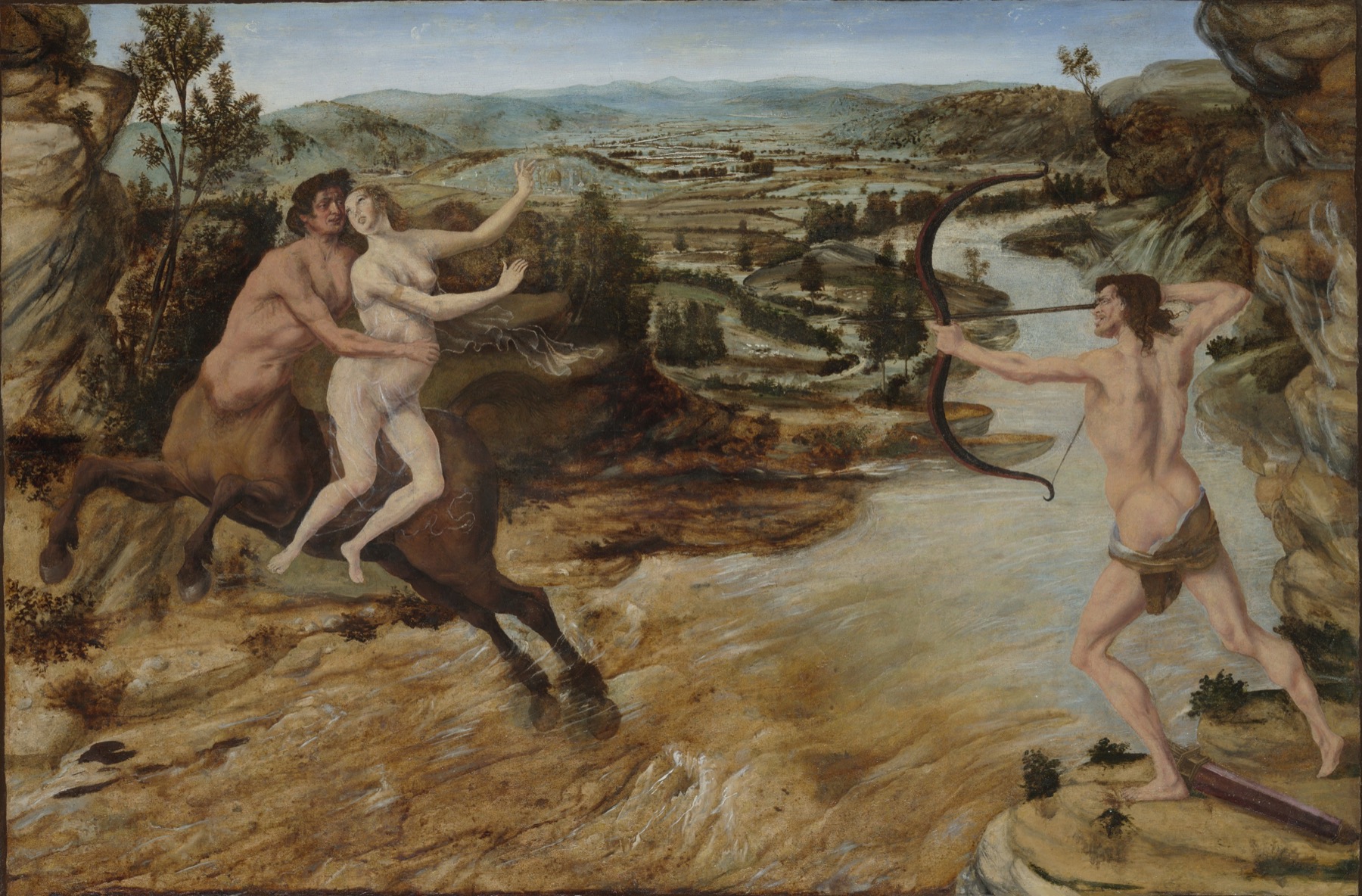
Describe the action without naming the myth. Then add the later consequence. What changes in your interpretation of Hercules's violence and Deianira's position?
Check your understanding
Why does the later part of the myth matter?
Darkness to Light: Garofalo's The Conversion of Saint Paul
Garofalo's painting presents the conversion of Saul on the road to Damascus. The event is both physical and spiritual: a man who has been persecuting Christians is struck down and confronted by a divine presence.
The lecture pays attention to how the image makes an invisible transformation visible. Light, direction, the fallen body, and the reactions of the surrounding figures turn a theological change into a dramatic event. The painting does not only illustrate a story; it interprets what conversion feels like.
The account in Acts gives the scene a precise sequence. Saul is travelling to Damascus with authority to arrest Christians when a light from heaven surrounds him and a voice asks why he is persecuting Christ. He falls, becomes blind, and has to be led into the city. After three days Ananias restores his sight. The persecutor is not merely persuaded; he is physically interrupted, made dependent on others, and given a new public role.
Walsh compares the image with earlier versions of the subject, including Raphael's design for a tapestry in the Sistine Chapel. The comparison makes a useful distinction: the same story can be built around a spectacular divine intervention, the startled horse, the companions who do not understand, or the newly vulnerable body on the ground. Choosing the moment is already an interpretation of what conversion means.
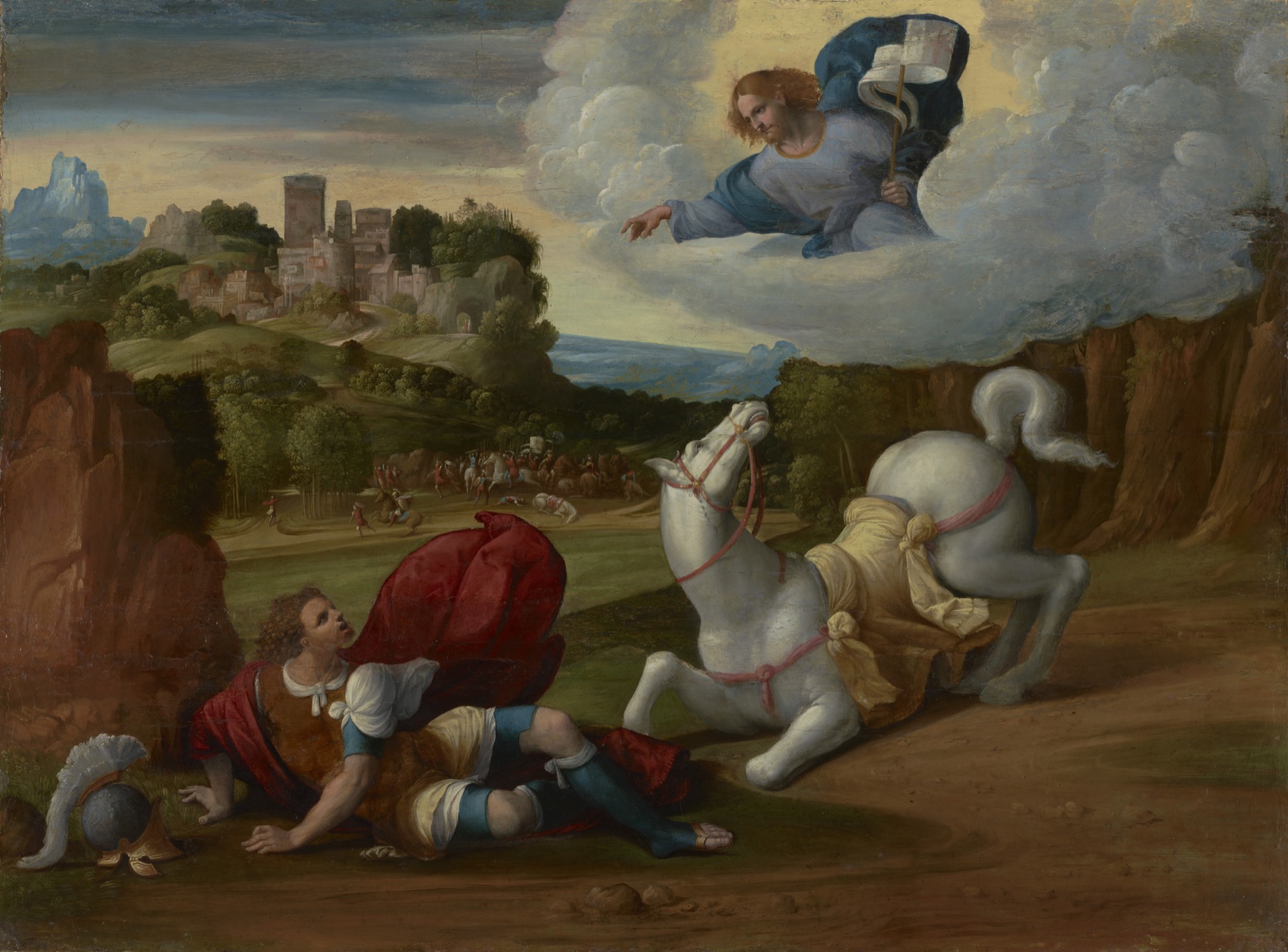
Choose one element - light, posture, gesture, or point of view - and explain how it makes Paul's transformation legible to someone looking at the painting.
Check your understanding
Which visual strategy does Garofalo use to make an invisible event pictorially legible?
“But, Lord, He Stinketh!”: Marco Pino's The Resurrection of Lazarus
Marco Pino's Resurrection of Lazarus depicts a Gospel story about doubt and salvation. Lazarus has been dead long enough for the practical fact of death - the smell, the tomb, the body's decay - to confront the promise of resurrection.
The lecture uses this tension to show how a painter can make a familiar religious story newly difficult. The miracle is not presented as an abstract doctrine. It takes place among bodies, expressions, gestures, and people who have to decide whether to believe what they are seeing.
The Gospel account is unusually physical. Martha first objects that Lazarus has been dead for four days and that there will be an odour. Jesus answers that belief will allow the glory of God to be seen, then calls Lazarus out of the tomb still wrapped in burial cloths. Pino keeps that physical difficulty in the image. The tomb, the exposed body, and the crowd's different reactions prevent the miracle from becoming a smooth, weightless symbol.
The lecturer follows the details that make the crowd readable. John the Evangelist holds a book marked by an eagle, an attribute that identifies him as the writer of the account and turns him into a visual witness. A dog looks alertly outward, a conventional sign of faithfulness. Another contemporary-looking head seems to watch the event and look toward us. Pino's problem is then one of virtuosity: he has to control a large gesturing crowd through waves of arms, drapery, and triangular groupings.
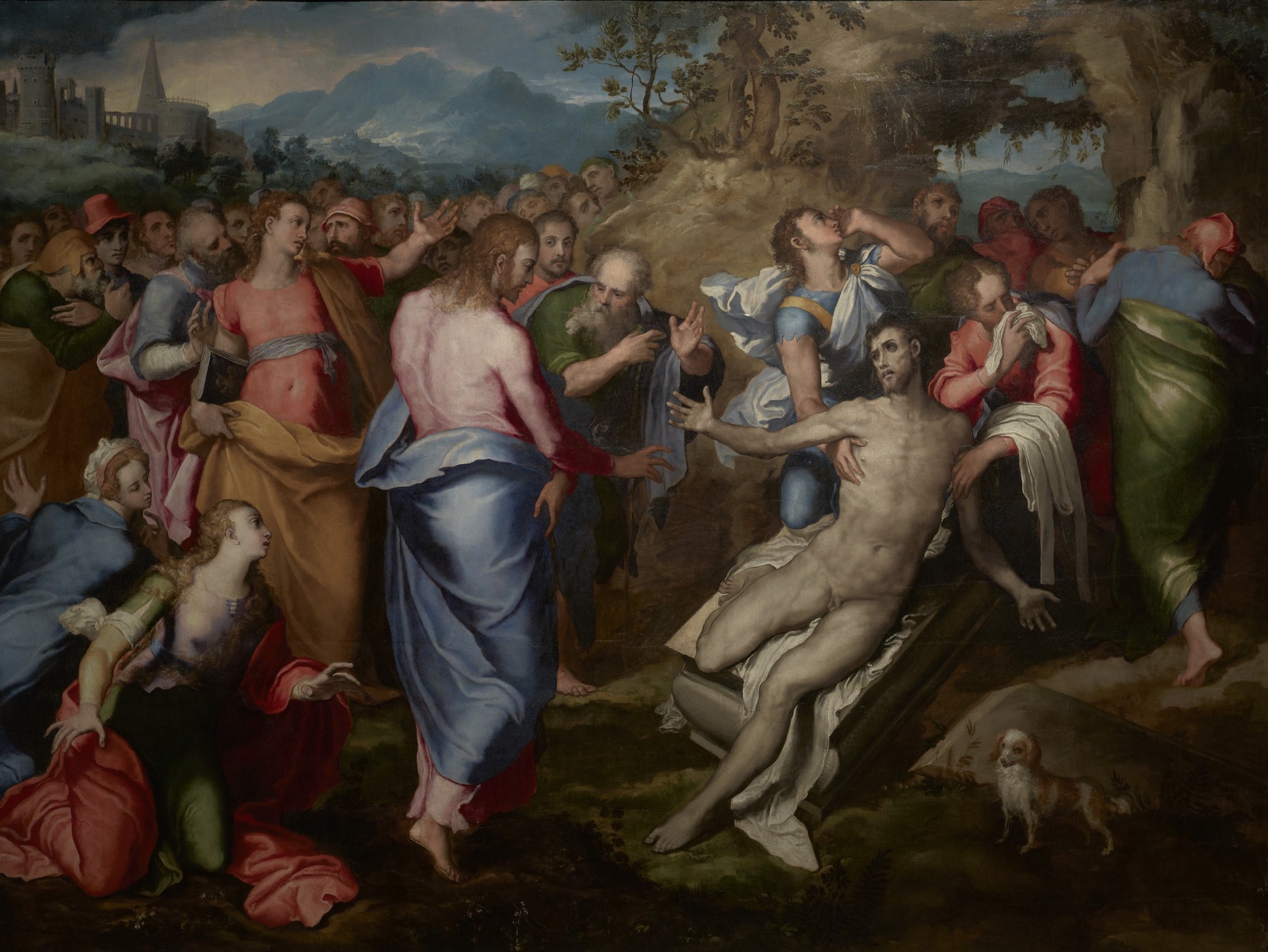
Find the figures who respond differently to Lazarus's return. What does each response add to the painting's argument about evidence, faith, and the body?
Check your understanding
What makes Pino's treatment of the subject distinctive?
Against Nature: Peter Paul Rubens's Hero and Leander
Rubens paints the climax of the story of Hero and Leander: Leander swims across the Hellespont to reach Hero, but the storm and the sea defeat him. Rather than showing only two lovers, Rubens invents a crowded world of sea nymphs, monsters, water, and violent motion.
The lecture asks what the lovers did wrong and why the painting makes the natural world feel almost morally charged. Their desire crosses a boundary - the sea, the night, the distance between cities - and the painting turns nature into an active force rather than a backdrop.
The ancient story, told by Musaeus and known through Ovid and later writers, is built on repetition: Leander swims every night from Abydos to Sestos, guided by the lamp Hero keeps burning from her tower. One winter night the sea becomes violent, the lamp goes out, and the swimmer loses the guide that made the journey possible. Rubens imagines the moment after the death, when sea nymphs gather around Leander's body and Hero's grief is already present in the scene.
That invention matters. The nymphs function almost like a wordless Greek chorus: they point, mourn, recoil, and make the storm legible as a collective event. The lecture connects this early painting to Rubens's education, his study of Titian and Michelangelo, and his later career as a court painter and diplomat. It also introduces his interest in Stoic thought: human beings cannot control the larger order of nature, but they can be judged by how they meet what happens to them.
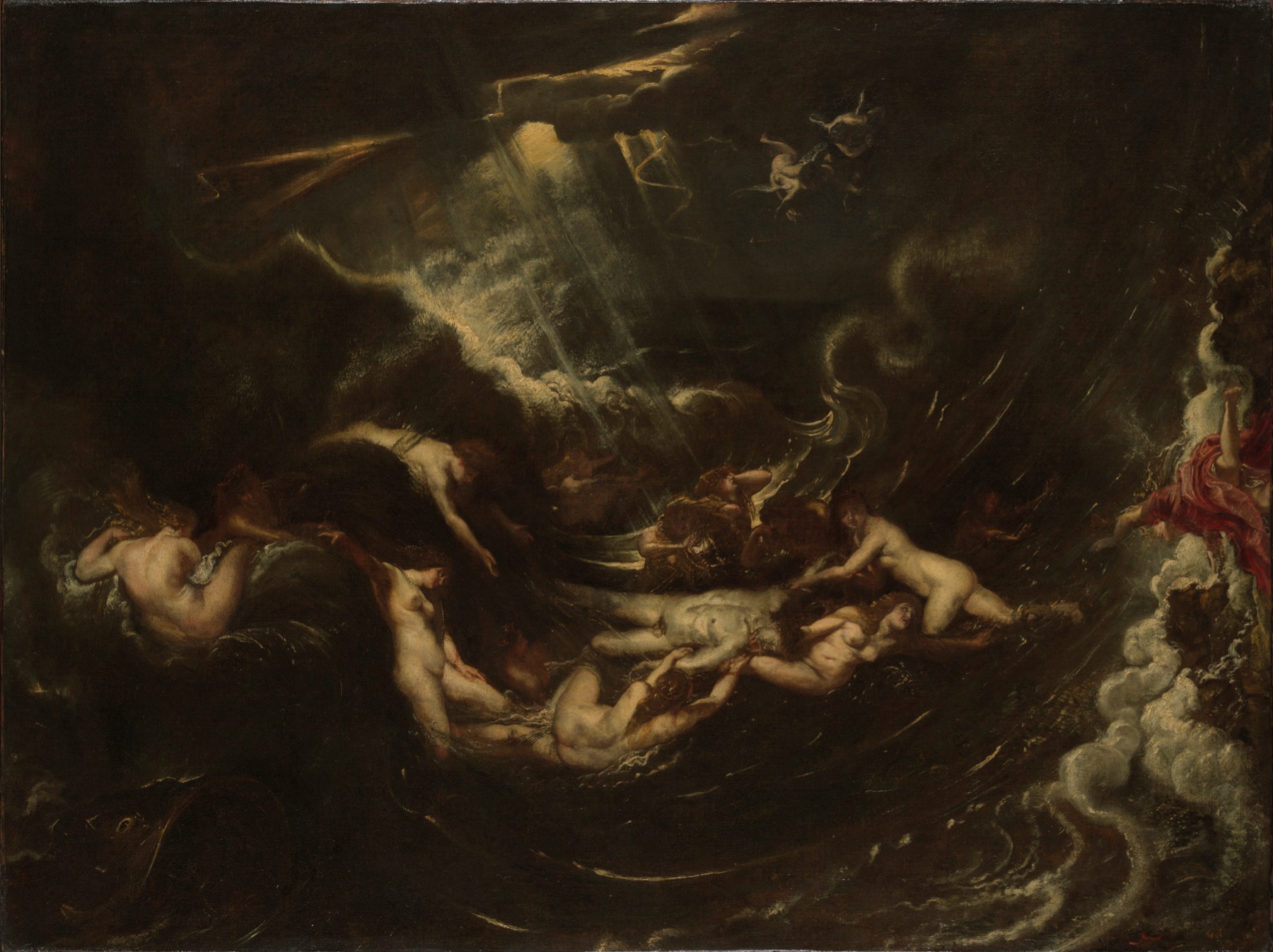
List every force that stands between Hero and Leander. Which are physical? Which are social or moral? How does Rubens make the separation feel excessive?
Check your understanding
Which feature best describes Rubens's style in this painting?
“To Paint the Way the Spartans Spoke”: The Death of Lucretia
Gavin Hamilton's neoclassical painting takes its subject from Livy's history of early Rome. Lucretia has been assaulted by Sextus Tarquinius and gathers her family before killing herself. Her death becomes the event that provokes the revolt against Rome's monarchy.
The lecture presents the painting as a model of moral and political clarity. The figures are arranged so that the private violation and the public consequences can be read together. Lucretia's body is not only a victim's body; it becomes the site where a story about virtue, honour, and political freedom is made visible.
Hamilton's Rome was not an imaginary backdrop. He lived among excavations, collections, tourists, dealers, and scholars. Herculaneum and Pompeii had recently been rediscovered, the Roman Forum was being cleared, and Johann Winckelmann was arguing that Greek art expressed a moral and political ideal. The Grand Tour made Rome a secular shrine and turned the study of antiquity into a social education.
The lecture follows the consequences of that education into Neoclassicism. Hamilton's bodies are not meant to look casually observed; their gestures are controlled so the moral action can be read. Lucretia's father, husband, and Brutus form a chain around the knife, and Brutus's raised arm converts private grief into a vow. The image asks us to see a political revolution being born inside a domestic tragedy.
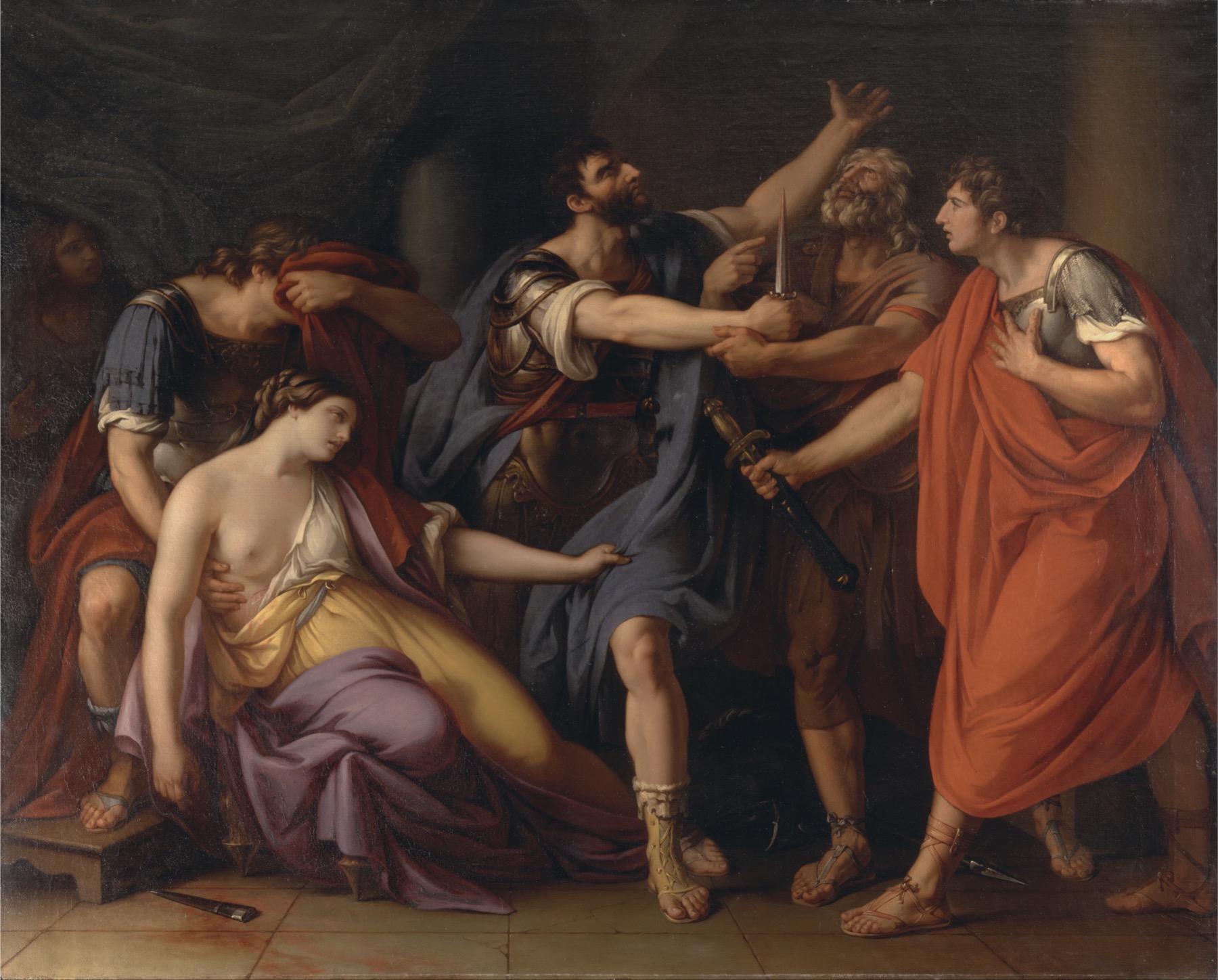
Explain how the painting moves from Lucretia's individual decision to the founding story of a republic. What visual details help make that transition?
Check your understanding
Which description best fits Hamilton's Neoclassical style?
Benjamin West's Agrippina Landing at Brundisium with the Ashes of Germanicus
Benjamin West's painting shows Agrippina arriving at Brundisium with the ashes of Germanicus. The source is Tacitus, whose account gives the event grief, political danger, public spectacle, and a woman who refuses to submit quietly to the cruelty of power.
West has to compress a long historical account into one image. The crowds, the urn, the children, the gestures of mourning, and Agrippina's posture make the story readable as both public ceremony and private defiance.
Tacitus describes Agrippina arriving after Germanicus's suspicious death with his ashes and children. The harbour and city walls are filled with people who do not know whether they should remain silent or express their grief. When she steps ashore, carrying the urn and keeping her eyes lowered, a single groan spreads through the crowd. West translates that passage into a theatre of attention: ships, balconies, soldiers, children, and mourners all direct us toward the pale central group.
The history is also about imperial suspicion. Germanicus had been popular with the army and had refused a possible coup against Tiberius; his loyalty did not save him from a court that feared his influence. Agrippina's public mourning becomes a political act because everyone understands what it implies. West makes the heroine's restraint carry the accusation. The crowd does not need a speech: its posture shows how private grief becomes public evidence.
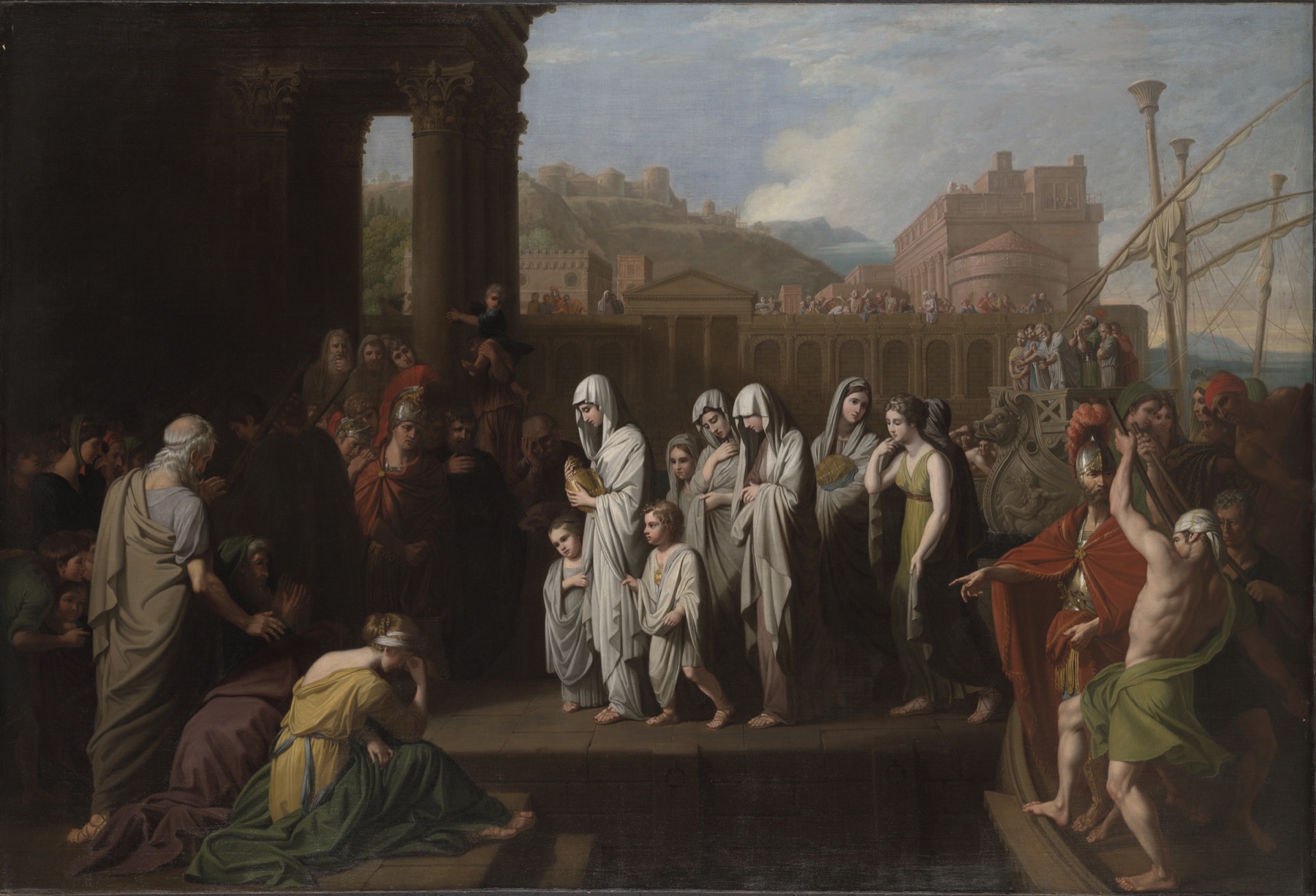
Take a short historical passage and choose the one moment you would paint. List the three details you would need viewers to see in order to understand its moral and political stakes.
Check your understanding
What is one of West's main achievements in this painting?
John Trumbull and Historical Fiction
Trumbull's Battle of Bunker's Hill has become an iconic image of the American Revolution: a noble death, brave resistance, and a field of combat arranged for moral clarity. Yet Trumbull could not have seen the intimate details he paints. He watched the battle from too far away.
The lecture therefore asks what it means for a history painting to be based on an event the artist witnessed but could not have observed in this form. The image is not simply false. It is a constructed account of what the event meant - courage, sacrifice, and the values a new nation wanted to remember.
Trumbull's own account supplies the factual frame. After Lexington, poorly armed and largely undisciplined colonists fortified Breed's Hill. They worked through the night and defended the position until their ammunition was exhausted. The British eventually took the field, but the American resistance and the death of Joseph Warren became central to the memory of the battle.
The painting joins several moments that could not have been seen together: Warren dying, Colonel Small restraining a British soldier's bayonet, British officers falling, exhausted Americans retreating, and a wounded Black attendant helping a white soldier. Trumbull had been present, but he was too far away to witness this intimate cluster. He reconstructs it from testimony, memory, earlier art, and moral purpose.
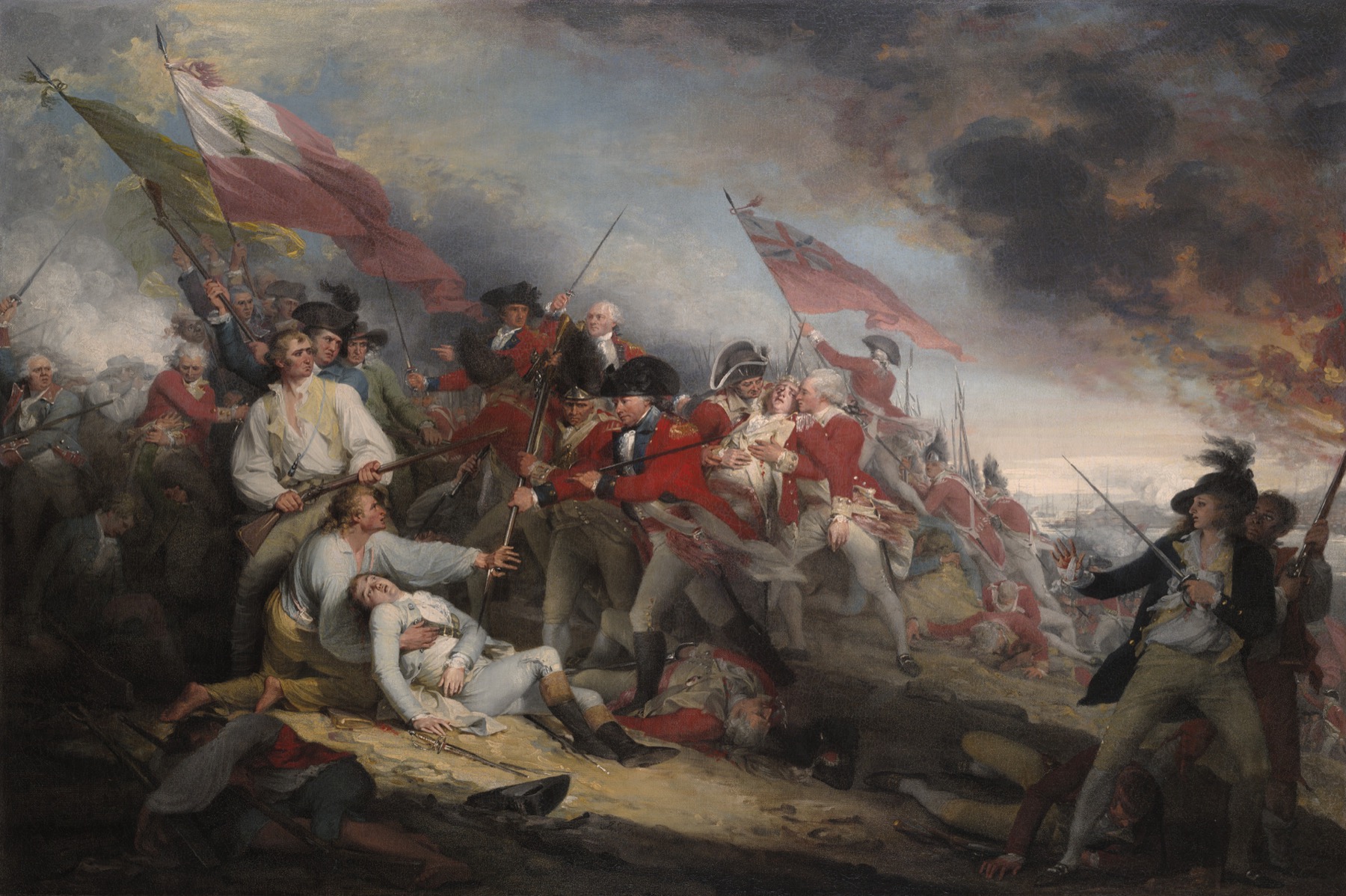
Choose one detail in a historical image. Ask whether it is documented, plausible, invented, or symbolic. What does the artist gain by including it?
Check your understanding
What does Trumbull's historical fiction reveal about history painting?
Find the Hero: Ary Scheffer's The Retreat of Napoleon's Army from Russia in 1812
Ary Scheffer's painting does not show a famous battle or a victorious commander. It shows the remnants of Napoleon's army after the disastrous retreat from Russia: exhausted figures, dead bodies, a dead horse, fire, and a mass of people still moving through the snow.
Where is the hero in a picture of defeat? The lecture argues that the painting shifts attention away from triumph and toward endurance, vulnerability, and the anonymous people who suffer history. The composition refuses the easy reassurance that pain is only a step on the way to victory.
The central mounted officer is not presented as a triumphant commander. His hand still makes the traditional gesture of command, but his leg is bandaged and he cannot hold his head up. Around him, the army has become a moving mass of brown uniforms, rifles, dead men, a butchered horse, and soldiers warming themselves at a fire. The small group is not a battle formation. It is a temporary halt in a disaster that has not finished.
Napoleon's Grande Armée entered Russia in enormous numbers and returned through distance, winter, hunger, disease, and repeated military failure. Scheffer's title names Napoleon's army, but Napoleon himself is absent. The picture makes the consequences of command visible without allowing the commander to absorb the suffering into a single heroic body.
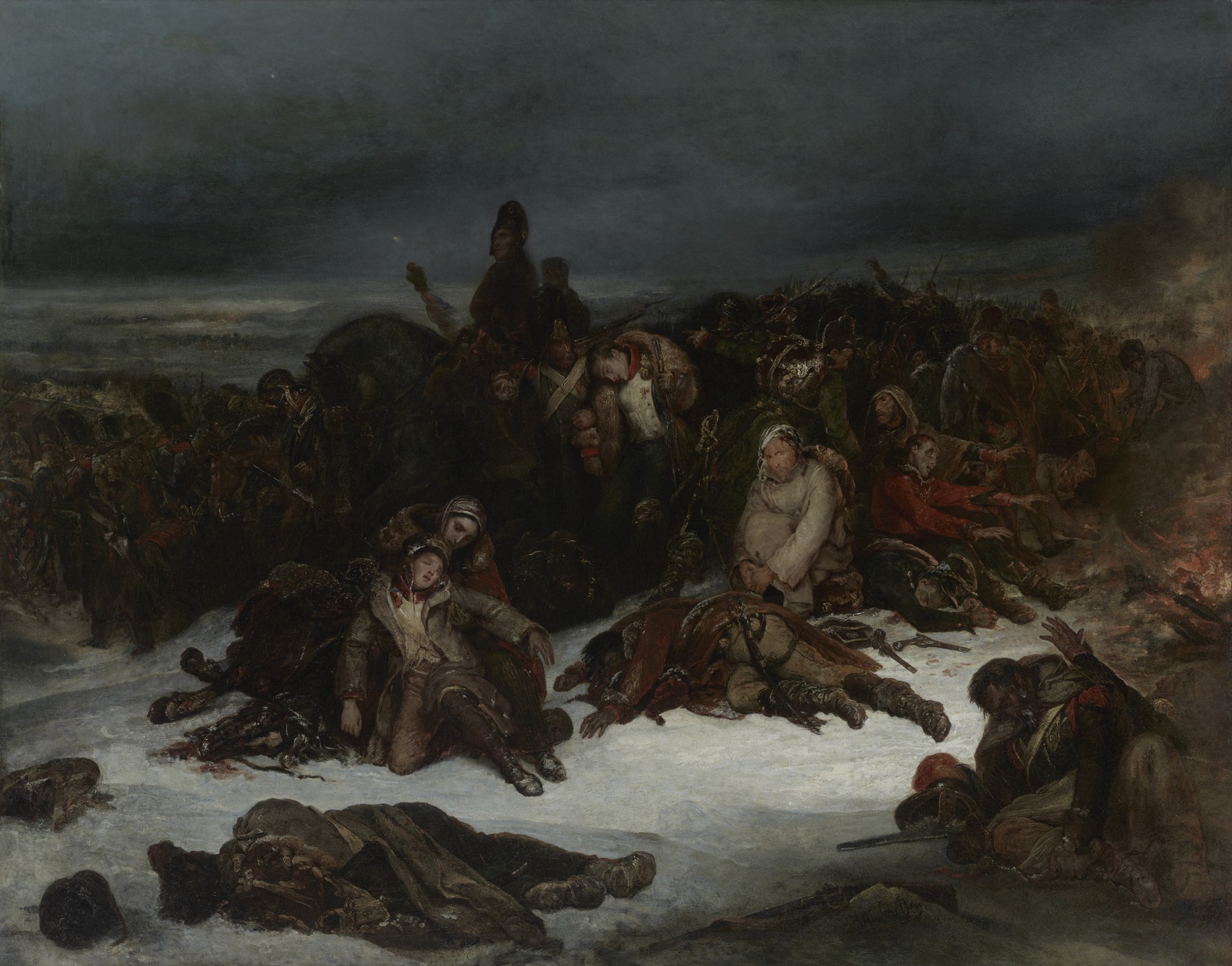
Give the painting three possible titles: one focused on military history, one on individual suffering, and one on collective survival. What does each title make you notice?
Check your understanding
How does Scheffer's Romantic treatment challenge conventional heroic history painting?
Handwriting on the Wall: John Martin's Belshazzar's Feast
John Martin's Belshazzar's Feast shows the Babylonian king at the instant when a hand writes a warning on the wall. The lecture begins with the Biblical text because the first audience was expected to recognise the story: sacred vessels are abused, a king boasts, and an unreadable message announces judgment.
Martin turns this into a theatrical scene of architecture, light, spectacle, and catastrophe. The gigantic hall makes the king's feast look both magnificent and ridiculous. The painting's scale is part of its argument: human power can build an astonishing world and still be brought down by a message it cannot read.
The Biblical passage gives the image its sequence. Belshazzar orders the gold and silver vessels taken from the Temple in Jerusalem to be brought to his feast. While the king and his guests praise gods of metal and stone, a hand writes on the plaster. The astrologers cannot interpret it. Daniel reads the words as a judgment: the kingdom has been weighed and found wanting, and that night Belshazzar is killed.
Martin's career explains the painting's unusual afterlife. He made enormous visions of the Apocalypse, floods, Babylon, and the destruction of cities; his images were reproduced as prints, posters, panoramas, and theatrical spectacles. His Babylon is therefore both an Old Testament warning and a modern entertainment machine. The lecture connects that mixture to Thomas Cole's later images of the rise and fall of empire.
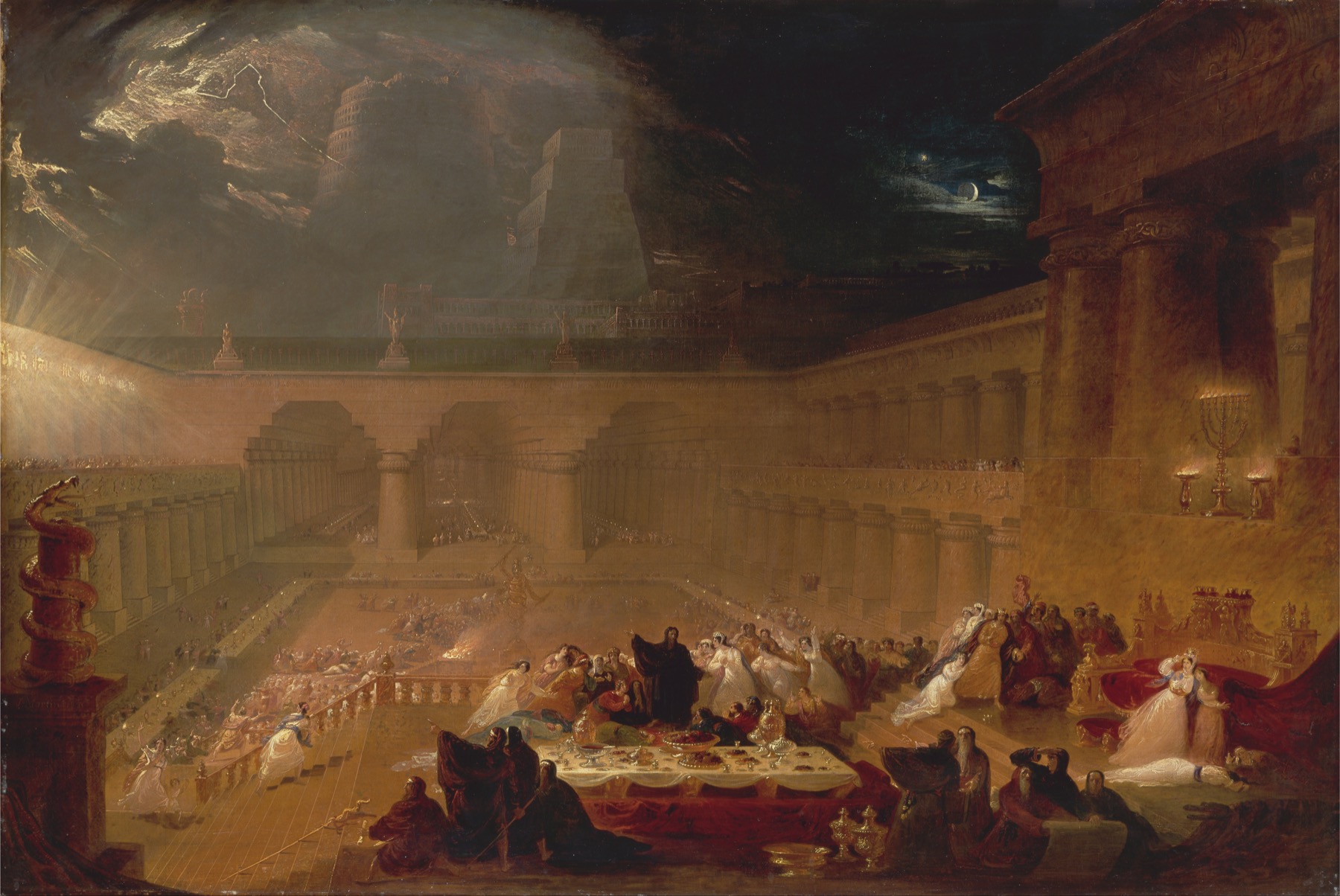
Identify the visual signs of power in the painting, then identify the signs that power is failing. How does Martin make those two states coexist?
Check your understanding
What makes John Martin's style especially scenographic?
History at the Academy & the Salon: Jean-Léon Gérôme's Ave Caesar! Morituri te salutant
Jean-Léon Gérôme's Ave Caesar! Morituri te salutant shows gladiators in an ancient Roman arena. The painting belongs to a moment when history painting remained popular while new ideas about subject matter, Realism, Impressionism, photography, and cinema were undermining its authority.
The lecture asks why this picture was so frequently reproduced and what its realism actually means. Gérôme constructs an ancient world that feels researched, theatrical, and immediately legible. The painting is not just an academic exercise: it anticipates the visual pleasures and historical fantasies that later move through photography and film.
The scene is not an episode recorded in Roman history. Gérôme assembles it from clues. The emperor Vitellius presides over the arena, the Vestal Virgins watch from the left, and the gladiators include different professional types: heavily armed murmillos and the net-and-trident retiarius. Dead bodies are dragged away, sand is spread over blood, and Mercury and Pluto appear as theatrical figures who turn the arena into a ritual passage toward death.
That construction is exactly why the work became so persuasive. Gérôme researched weapons, costumes, architecture, and the imagined Colosseum, even though the building shown was not standing in Vitellius's time. The Salon rewarded this kind of antiquarian authority, while photography and cinema later made the same combination of research, staging, and spectacle even more powerful.
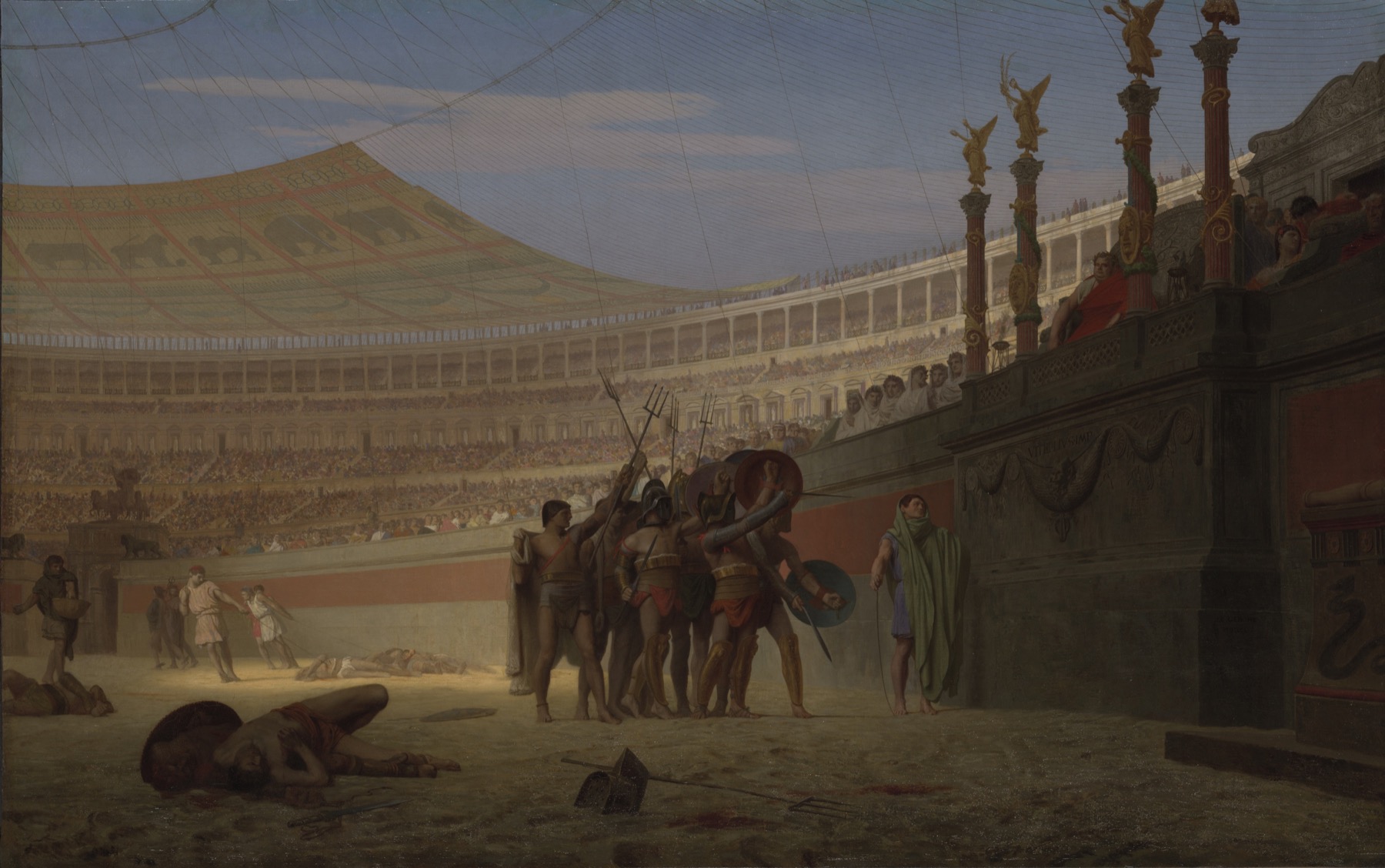
List three details that make the scene feel historically convincing. Then ask whether each detail provides evidence, atmosphere, or theatrical effect.
Check your understanding
Which historical change does Gérôme's work help illuminate?
History Painting after Two World Wars: Anselm Kiefer's Die Ungeborenen
Anselm Kiefer's Die Ungeborenen reaches into myth and science to think about recent German history. After two world wars and the crisis of representation that followed, can art still give history a moral form?
The lecture returns to the course's opening problem. History painting had lost its official prestige, and abstract art had challenged the importance of recognisable subjects. Kiefer's work nevertheless tries to revive historical consciousness - not by pretending that the past can be pictured transparently, but by making memory, destruction, absence, and responsibility part of the work's material.
In the original, the scale and material are difficult to reproduce on a screen. The work is more than ten feet wide and painted on two thin sheets of lead fixed to canvas. A rooted shrub is wired into the surface; small dresses, smocks, and ponchos are scattered across it like children's clothes. White plaster or paint has cracked and fallen away. The work does not show a historical event, but its materials make damage, absence, and the weight of the past physically present.
Kiefer links this material language to myth and memory. The figure of Lilith, the dresses without bodies, and the references to unborn or absent lives invite associations with Jewish folklore and the Holocaust without turning the subject into a single illustrated scene. This is the final transformation in the lecture's argument: history painting can survive after narrative certainty has collapsed, but it may need to make the viewer experience fragments, uncertainty, and responsibility.
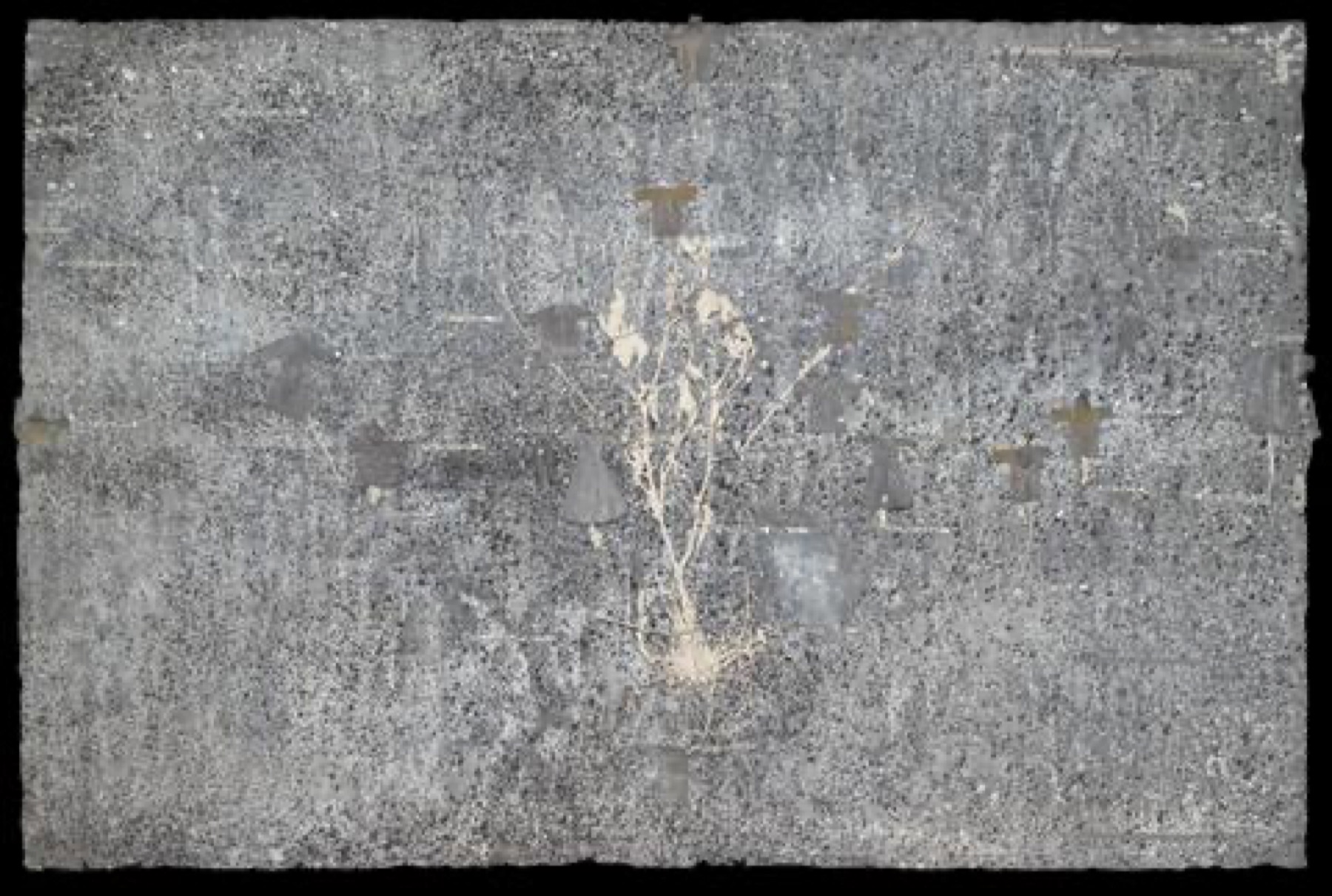
Choose one earlier painting and compare it with Kiefer's work. What changed about the role of story, heroism, and moral instruction? What survived?
Check your understanding
What does Kiefer's work suggest about history painting after the twentieth century?
History painting is a way of making the past matter
Across twelve lectures, the paintings repeatedly turn stories into choices: which moment to show, which body to centre, what to invent, what to omit, and what viewers should learn from the scene. The paintings are not neutral illustrations of history. They are arguments about heroism, faith, desire, grief, violence, power, defeat, and memory.
The method to keep is simple: learn the story, look closely, reconstruct the choices, and ask what the image wants the viewer to feel or understand. Then ask who is missing, what has been changed, and what kind of history this picture makes possible.
Full texts: twelve lecture transcripts preserved in the project references folder.
Public source: Open Yale Courses ↗ and the Yale lecture playlist ↗.
Lecturer: John Walsh, Yale University Art Gallery.
Note: this page is a structured synthesis of the lectures, not a replacement for the paintings, the full recordings, or the original transcript text.