Making Books: The Renaissance and Today
A course about what changes when the way we record and distribute words and images changes.
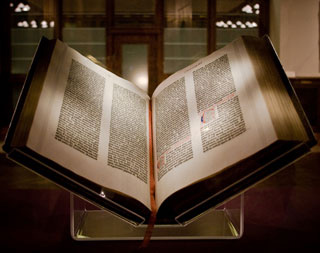
This course follows MIT's original course through three linked activities: studying the history of the book from Gutenberg to the French Revolution, examining rare books and prints, and building a functioning hand-set printing press.
The central question is not simply Who invented printing? It is: what happens to knowledge, authority, reading, and making when a medium changes? The course also asks whether our digital moment should be understood as another media transition.
How to use this mini-course
Each module keeps the original course's sequence and named objects, then adds a plain-language explanation of what to look for. The questions are there to make you notice relationships between an object's form and its use. They are not substitutes for handling the objects or reading the assigned books.
Think of one technology you use to record or distribute words and images. What does it make easy? What does it make difficult? Keep that example in mind as the course moves from manuscripts to printing presses to digital media.
MIT OpenCourseWare 21H.343J / CC.120J, taught by Anne McCants, Jeffrey S. Ravel, and Kenneth Stone. The archive includes the syllabus, calendar, lecture slides, readings, assignments, instructor insights, archival-object pages, and construction photographs. Open the original MIT course ↗
Paper, type, and the press
Before studying the European printing press, the course begins with writing media: cuneiform tablets, khipu, scrolls, manuscripts, and paper. This matters because “the book” is not a single technology. It is a set of material choices about surfaces, marks, tools, binding, storage, and circulation.
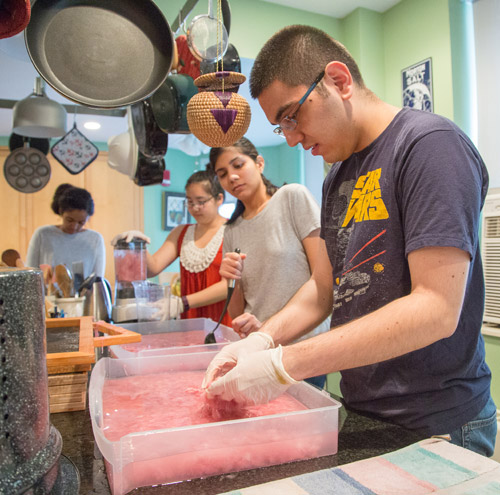
The first lecture sequence then moves to paper-making and pre-1800 presses. The slides compare eighteenth-century paper-making in France with traditional paper-making in twenty-first-century Nepal. They also introduce the parts and actions of a hand press: type, ink, paper, the form, the bed or “coffin,” the tympan, the frisket, and the platen.
What the press changes
Movable type allows the same form to produce multiple copies. That repeatability is a major change from copying a manuscript by hand, but it is not the same thing as instant mass communication. A press needs paper, type, labour, capital, distribution networks, readers, and institutions willing to print and circulate particular texts.
The course's first paper asks students to assess a strong claim: that movable type democratized communication and decisively changed political and religious hierarchies. The assignment is useful because it turns the “printing revolution” into a question to argue about, not a fact to memorize.
Choose a contemporary digital publication. List the material and social steps between a writer's draft and your screen. Which steps are visible to you? Which are hidden? Compare this with the press sequence above.
Lecture slides on pre-1800 books, paper, and printing presses and on paper-making are preserved locally as full PDFs. The original course also names Febvre and Martin's The Coming of the Book and Pettegree's The Book in the Renaissance; those books are bibliographic references, not full texts in the archive.
The book is an object, not just a container for words
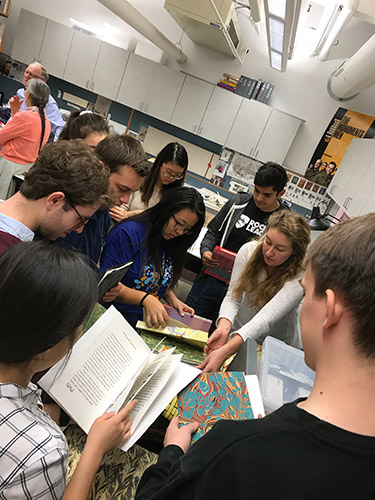
The course turns from the press to particular objects: a Parisian Book of Hours from around 1450 and the Nuremberg Chronicle from 1493. Looking at them means noticing more than their written content. We can ask who commissioned them, how a reader navigated them, what images do, how pages are ordered, and what traces previous owners left behind.
A Book of Hours is organised around prayers and saints' days. Its pages create a rhythm for devotion: text, image, calendar, and repetition. The Nuremberg Chronicle presents world history through a large visual and textual structure, including the seven ages of the world, genealogies, cities, biblical stories, and images of rulers.
| Object | What to inspect | Question to ask |
|---|---|---|
| Book of Hours | Calendar, prayers, images, page sequence | How does the object organise devotional time? |
| Nuremberg Chronicle | Chronology, images, city views, ownership traces | How does the object make world history legible? |
The distinction between manuscript and print is also less absolute than a simple before-and-after story suggests. Early printed books borrow page layouts, type styles, abbreviations, and visual conventions from manuscripts. Readers encountering a new technology often understand it through older forms.
Use the three-part method from this module: describe one visible feature, infer what action it invites from a reader, then name what evidence would be needed to support that inference. Keep description and interpretation separate.
Check your understanding
Why does the course ask students to study books as physical objects?
Print, religion, and the production of knowledge
The next sequence follows printed religious materials and early modern natural philosophy. The slide sets include Erasmus's Novum Instrumentum, polyglot Bibles, papal decrees, images of Erasmus and Pope Julius II, and books about celestial and earthly bodies.
The point is not that print simply “caused” the Reformation or modern science. Print made certain forms of comparison, repetition, citation, translation, polemic, and circulation possible at new scales. But institutions still controlled access, readers interpreted texts in different ways, and printed authority remained contested.
The course's readings include Lee Palmer Wandel on “The Word” in the Reformation, Adrian Johns on the relationship between the book of nature and the nature of the book, and chapters from Pettegree. These readings push against technological determinism by asking how practices of reading and institutions of knowledge change together.
Images do intellectual work
Woodcuts, engravings, diagrams, portraits, maps, and title pages are not decorative extras. They establish authority, make a person recognisable, organise an argument, or show a process. A visual form can be copied and reused while its meaning changes with the book and audience around it.
Put a religious image and a scientific image side by side. Describe how each creates authority: through a person, a diagram, a quotation, a symbol, a source, or a claim to direct observation. Then ask what each image leaves out.
The archive preserves the lecture slide decks on the Bible in print, Reformation images, Renaissance religion, and natural philosophy. The named books and articles are listed in the original reading schedule; most are bibliographic references only.
Readers make meaning: the case of Menocchio
The course then narrows from the history of print to one reader: Domenico Scandella, known as Menocchio, a sixteenth-century miller whose words were recorded during trials before the Inquisition. Carlo Ginzburg's The Cheese and the Worms reconstructs what his reading and statements can tell us about popular culture, authority, and interpretation.
Menocchio had a small library, but he did not simply repeat what his books taught. He combined fragments, compared passages, argued with religious authorities, and produced ideas of his own. The student example The Thinker emphasises this as critical reading: a reader with limited access can still transform a text through comparison and argument.
The assignments make this principle concrete. Students are asked to analyse Menocchio's theological and social ideas in relation to the books Ginzburg identifies, or to write from the perspective of someone who knew him. The point is not to invent freely; it is to make an argument constrained by sources.
Choose one claim made by a historical reader. Separate: (1) what the source directly records, (2) what the historian infers, and (3) what you might hypothesise. This separation protects the reader's complexity without pretending to know more than the evidence allows.
Check your understanding
What does the Menocchio case help the course study?
The archive preserves the first- and second-paper prompts and three anonymous student examples. Ginzburg and Del Col are required books named by the course but are not preserved in full locally.
Making as a historical method
The course's most unusual element is also its argument in physical form: students build a working hand-set printing press and make cotton rag paper for it. The building is not an extra craft activity added after the “real” history. It changes what students can understand about the labour, precision, materials, and time involved in printing.
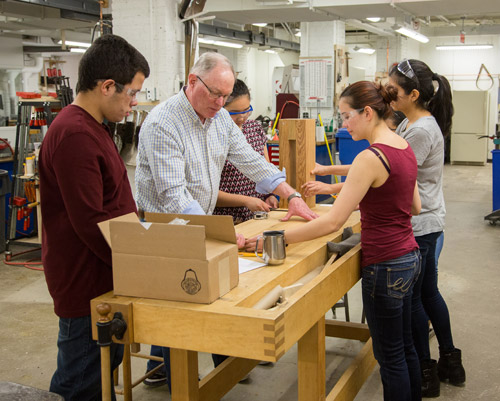
The Beaver Press uses a wooden tower frame, a large screw and nut, a bed or coffin, a platen, a tympan, and a frisket. To print, students hand-set type into a form, secure it with furniture and quoins, ink the type, place paper on the tympan, and pull the handle to press the paper against the type.
Professor Ravel describes the course as balancing readings, rare objects, construction, and paper-making. The instructor insights also admit the improvisational problem: the press might take longer than planned, so the intellectual and practical parts had to remain flexible.
From press to digital media
The original course asks what parallels exist between early modern print and today's media landscape. The answer is not that digital media is “the same” as print. The useful comparison is more precise: both moments force people to rethink authority, distribution, speed, access, labour, and the relationship between a form and the ideas it carries.
Choose one digital object - a newsletter, website, ebook, or social post. Describe its equivalent of type, paper, press, distribution, and reader trace. Which parts can you alter? Which parts are controlled by systems you cannot see?
The archive preserves the Beaver Press construction notes, diagrams, photographs of building and printing, and instructor reflections. The press design is a modern reconstruction adapted for a semester-long student project, not an untouched historical artefact.
A book is a social and material system
Making Books moves from surfaces and tools to objects, readers, institutions, and hands. Gutenberg matters, but he is only one point in a much larger system. The history of the book is also a history of paper-makers, compositors, printers, binders, readers, collectors, censors, students, historians, and the physical objects that preserve their choices.
The course's most durable method is to put three things together: read the scholarship, inspect the object, and make something yourself. Each reveals what the others leave abstract.
Full texts and course pages preserved locally: syllabus, calendar, lecture slides, assignments, student examples, instructor insights, Beaver Press construction notes, and image galleries.
Bibliographic references: Ginzburg, Del Col, Pettegree, Febvre and Martin, Johns, Wandel, Clanchy, and other readings named in the original schedule.
Public source: MIT OpenCourseWare - Making Books: The Renaissance and Today ↗.
Licence: the original MIT course is published under CC BY-NC-SA 4.0; individual images and student examples may have separate credits or restrictions, which are retained in the archive metadata.